Your System Shapes the Customer Experience
Customer experience is not only about how friendly your team is or how attractive your website looks. It is also shaped by the systems that operate behind every customer interaction.
When a customer sends an inquiry, books a service, requests information, or makes a purchase, they expect the process to be simple and responsive. Every delay, unnecessary step, or confusing interaction can negatively affect their perception of your business.
In other words, your system shapes your customer experience.
Slow Response = Bad Experience
Customers expect businesses to respond quickly.
A slow response can create uncertainty. Customers may wonder whether their message was received, whether their request is being processed, or whether the business is reliable.
This becomes even more important for service-based businesses where customers often need quick answers before making a decision.
A well-designed system can reduce unnecessary delays by organizing information, automating repetitive tasks, and making important customer data easier to access.
Faster internal processes ultimately create faster customer responses.
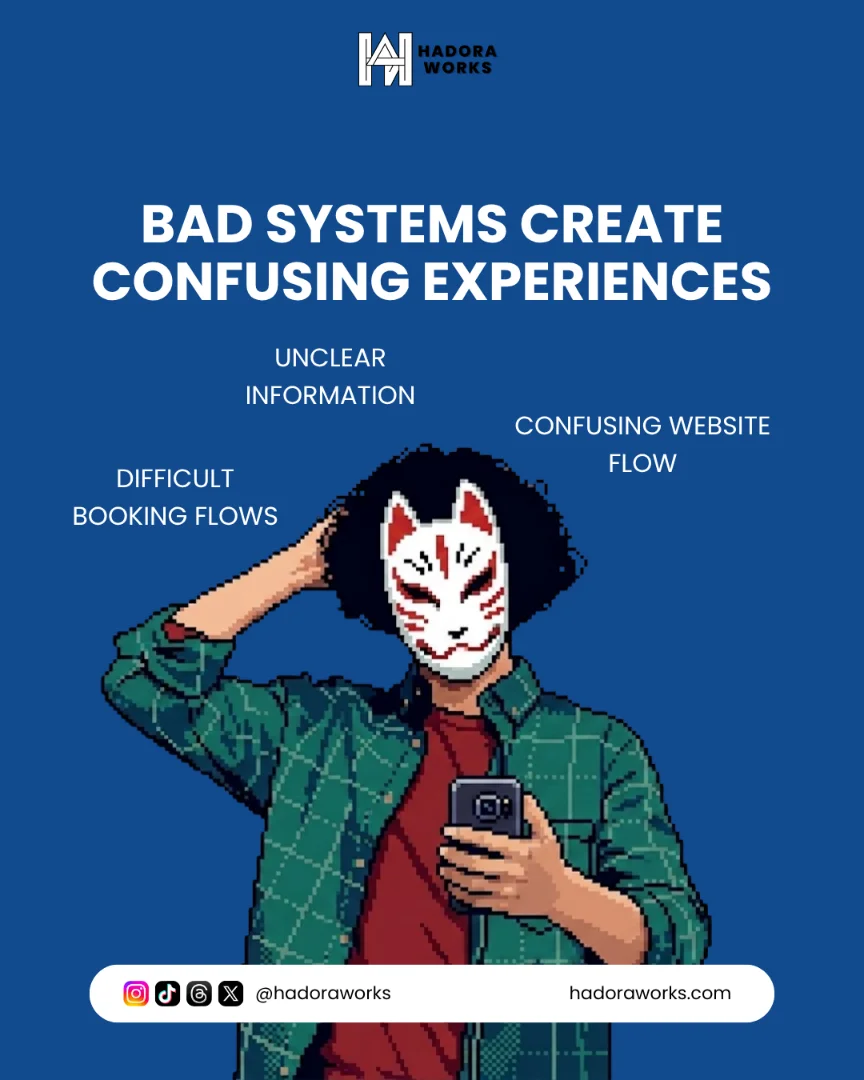
Bad Systems Create Confusing Experiences
A poorly designed system can make even a good service feel complicated.
Unclear information, difficult booking flows, confusing website navigation, and disconnected processes force customers to spend more effort than necessary.
For example, a customer should not have to navigate through multiple unnecessary pages just to book a service. They should not need to repeatedly provide the same information because different parts of the business are not connected.
When the system is confusing, the customer experiences that confusion directly.
The Best Systems Feel Effortless
The best systems are often the ones customers barely notice.
A structured system connects communication, operations, and customer interactions into a clear workflow. Information moves efficiently, tasks are handled consistently, and customers can complete what they need without unnecessary friction.
This creates an experience that feels natural:
Customer request → Efficient process → Fast response → Satisfied customer
Technology plays an important role in making this possible. Automation, centralized data, integrated workflows, and well-designed interfaces can eliminate repetitive work while giving teams more time to focus on customers.
Better Operations = Better Experience
Customer experience is closely connected to internal operations.
When business operations are well structured, several areas can improve:
Response speed
Workflow consistency
Customer communication
Service quality
Operational efficiency
These improvements do not only benefit employees. They directly influence how customers experience the business.
Better internal operations create smoother customer interactions, stronger relationships, and greater consistency across every touchpoint.
Better Systems Create Better Experiences
Building a better customer experience does not always mean adding more features.
Sometimes, the biggest improvement comes from simplifying the system, removing unnecessary steps, connecting disconnected processes, and making information easier to access.
A business with efficient systems can respond faster, operate more consistently, and provide customers with a smoother journey.
Better systems create better experiences.
And when better experiences lead to stronger customer relationships, better systems become more than an operational investment—they become a competitive advantage.